Karryn’s Prison Screenshots








Karryn’s Prison review
A comprehensive guide to the simulation and strategy elements that define this unique title
Karryn’s Prison stands out as a uniquely designed simulation experience that blends multiple gameplay genres into a cohesive whole. Players assume the role of Karryn, the newly appointed Chief Warden of a notoriously lenient prison facility that has recently experienced a major riot. The game combines prison management mechanics with character progression systems, creating an experience that emphasizes player choice and consequence. With its polished blend of simulation elements and strategic decision-making, Karryn’s Prison offers approximately 12 hours of gameplay on easier difficulty settings. The title has garnered attention for its innovative approach to integrating narrative progression with interactive mechanics, making it a notable entry in its genre.
Core Gameplay Mechanics and Systems
So, you’ve taken on the role of Warden Karryn, and the prison gates have slammed shut behind you. Welcome to your new office! 😅 If you’re wondering how does Karryn’s Prison gameplay work, you’re in for a treat. It’s a brilliantly bizarre fusion of a tough-as-nails prison management simulation and a deeply personal character-driven story. You’re not just managing a facility; you’re managing yourself, your reputation, and your very soul. This chapter is your key to understanding the intricate clockwork that makes this game tick. We’re breaking down the core gameplay mechanics and systems that define this unique experience, from the strategic menus to the weight of every choice you make.
Let’s dive into the systems that make this prison run.
Prison Management and Warden Responsibilities
Forget everything you think you know about management sims. 🏢 In Karryn’s Prison, you’re not a distant overseer clicking on icons from a god’s-eye view. You are in the prison, walking the halls, facing the inmates directly. Your warden management strategy is a hands-on, daily grind. This is the heart of the prison management simulation, and it’s all about resource allocation, routine, and rapid reaction.
Your day starts with the Daily Schedule. This is your command console. Here, you assign guards and inmates to various facilities: the Workshop for generating income, the Kitchen to keep everyone fed (and happy), the Yard for exercise, and the Infirmary for healing. It sounds standard, but the magic—and the tension—lies in the trade-offs.
My Personal Rule: Early on, I poured everyone into the Workshop to make money fast. Big mistake. With no guards in the Yard, fights broke out constantly. I was rich in coins but constantly at low health from breaking up brawls, which made me… vulnerable in other ways. Balance is everything.
Each facility has a purpose that ties directly into core Karryn’s Prison gameplay mechanics:
* Workshop: The economic engine. More inmates working means more gold, but fatigued inmates are unhappy and prone to rebellion.
* Kitchen: Full bellies keep morale high. Neglect it, and you’ll have a riot on your hands faster than you can say “hunger strike.”
* Yard: Lets inmates burn off stress. No yard time means pent-up aggression, which leads to more frequent and violent confrontations.
* Infirmary: Critical for patching up guards and inmates after conflicts. A broken guard force is an ineffective one.
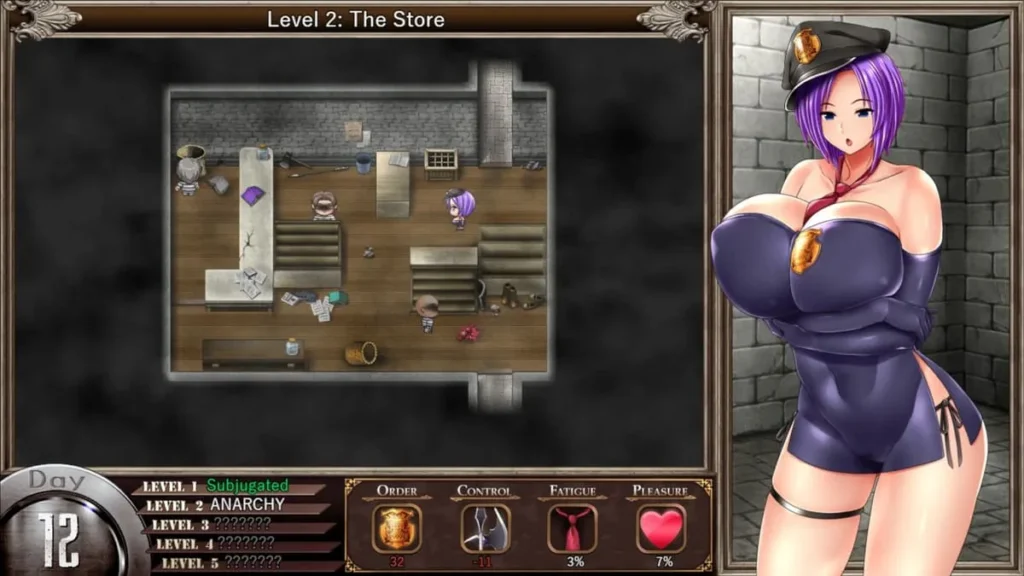
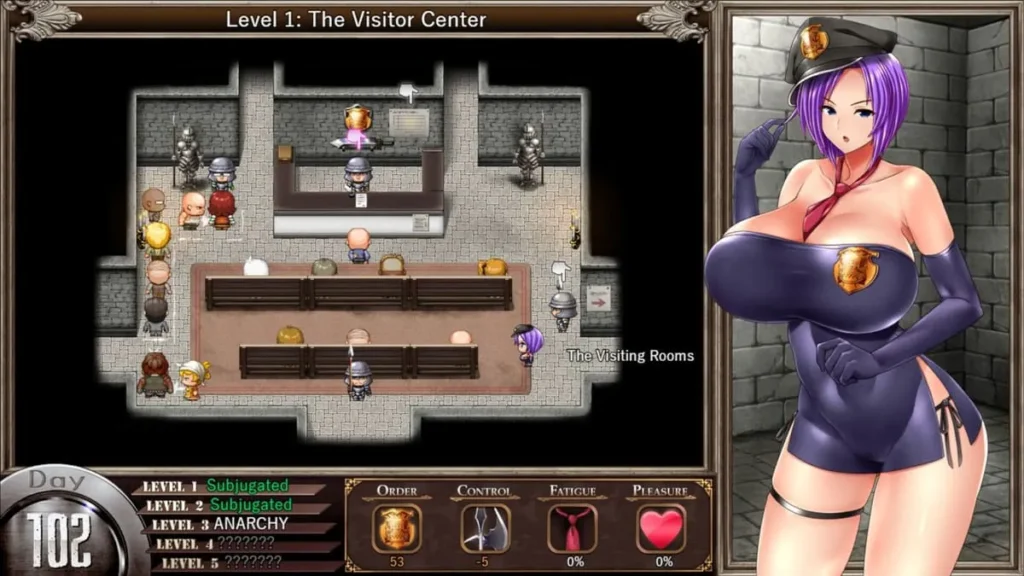
Your UI is your lifeline. A clean, informative heads-up display shows your Vitality (health), Stamina (for actions), Willpower (your mental fortitude), Gold, and the ever-important Prison Security level. Watching these bars fluctuate in real-time as you patrol is where the game truly shines. You’re not just managing numbers; you’re managing a living, breathing, and often lecherous environment.
To give you a quick-reference map of how these responsibilities intertwine, here’s a breakdown of the core systems at your fingertips:
| Core System | Primary Mechanics | Direct Player Impact | Narrative & Progression Integration |
|---|---|---|---|
| Facility Management | Assigning inmates/guards to Workshop, Kitchen, Yard, Infirmary via Daily Schedule. | Controls gold income, inmate morale, stress levels, and health recovery. Directly affects resource availability for upgrades and bribery. | Low morale increases confrontation frequency, driving both combat and corruption opportunities. Gold funds narrative-advancing upgrades. |
| Security & Patrol | Manual hall patrols, responding to incident alerts, equipping guard gear, using restraint commands. | Player’s physical interaction with the prison. Prevents contraband spread, stops fights, directly engages the character corruption system. | Every interaction with an inmate is a role-playing moment. Choosing to be harsh or lenient shapes Karryn’s reputation and opens or closes story paths. |
| Resource Economy | Earning gold from Workshop, spending on facility upgrades, guard equipment, and personal items. | Strategic choices between strengthening prison security vs. personal empowerment. Limited funds create meaningful dilemmas. | Upgrades like the Security Office unlock new narrative events and management options. Personal items can accelerate or mitigate corruption. |
| Inmate Status Tracking | Monitoring individual inmate stats like Fatigue, Stress, Obedience, and unique traits. | Enables targeted management. A stressed inmate might need Yard time; a disobedient one might need a personal “talk.” | Inmates with unique traits often have special event chains. Managing them well can lead to powerful allies or dangerous adversaries. |
This constant juggling act is what defines the opening hours. You’ll be micromanaging schedules, then sprinting down a corridor to break up a fight, then ducking into your office to buy a better lock for the contraband room. It’s exhausting, immersive, and incredibly rewarding when your warden management strategy finally clicks and the prison runs smoothly… for a few hours, at least. 😮💨
Character Progression and Corruption Mechanics
Now, let’s talk about the elephant in the cell block: the character corruption system. This isn’t a simple “good vs. evil” meter. It’s a nuanced, multi-faceted reflection of Karryn’s mental and physical state, deeply woven into the Karryn’s Prison gameplay mechanics. Your performance as warden and your personal interactions directly fuel this system.
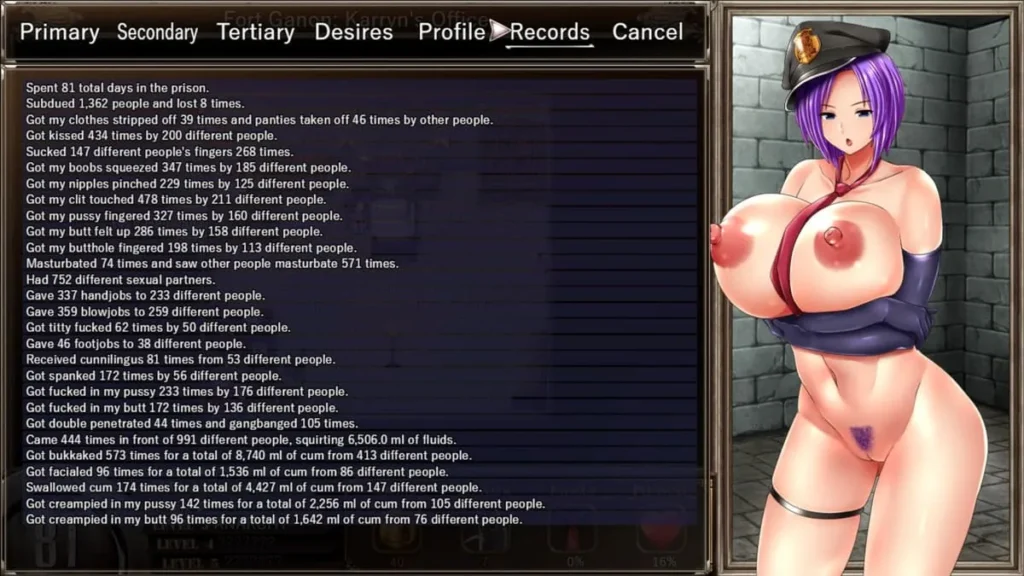
Your character sheet is your report card. Key stats include:
* Vitality: Your health. Depleted by losing fights or certain events.
* Stamina: Used for every action, from patrolling to using skills. Managing it is crucial.
* Willpower: Your mental resistance. The higher it is, the harder you are to corrupt. It’s eroded by certain inmate interactions and events.
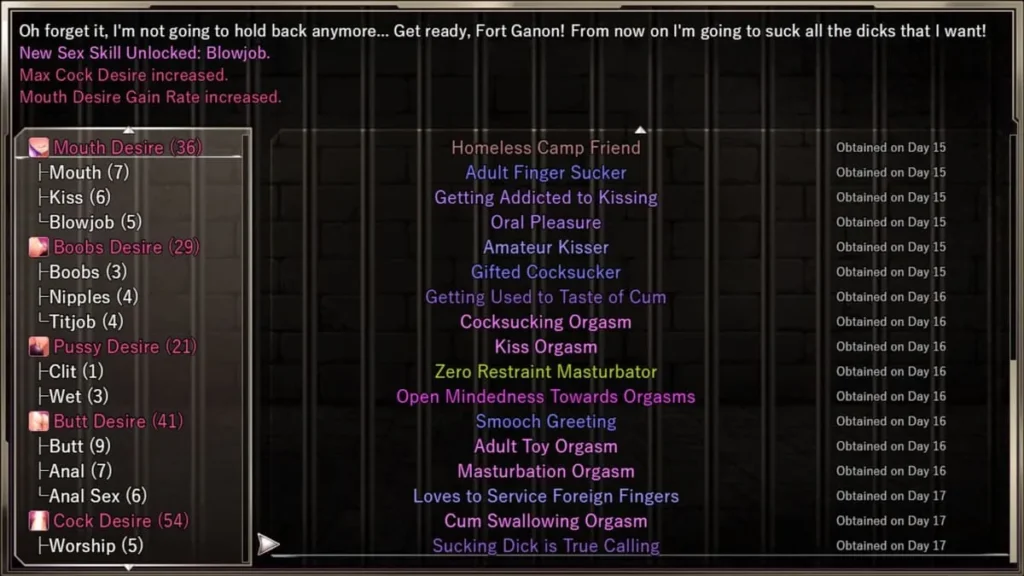
* Corruption: The infamous stat. It increases through specific failures, losses, or choices. It unlocks new dialogue options, abilities, and narrative branches but changes how the world perceives you.
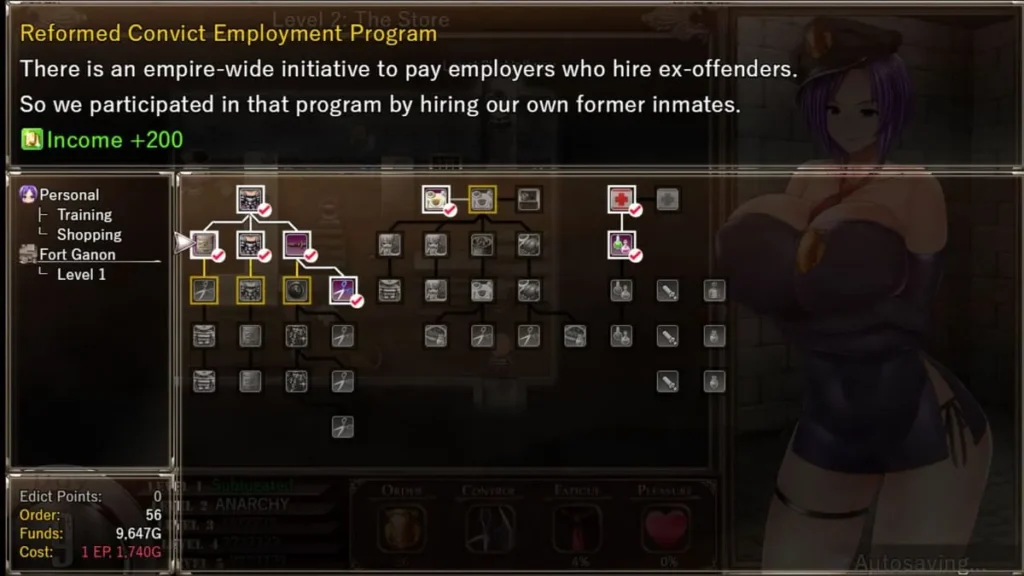
Progression happens in two ways: traditional and… transformative. You earn Experience from daily tasks and resolving incidents. Leveling up grants Skill Points to spend in a robust tree with branches for Combat (better fighting skills), Management (improved facility output), and Personal (stamina, willpower, etc.). This is where those JRPG mechanics Karryn’s Prison is known for come into play, providing a satisfying sense of growth and customization.
But the parallel track is Corruption-based progression. As your Corruption rises, you may unlock powerful, often risqué, abilities that can turn the tide in difficult situations. The game brilliantly makes corruption a tempting strategic choice. Is losing a fight on purpose to gain a potent new skill worth the permanent stain on your character? That’s a decision only you can make.
Let’s look at a specific example of cascading consequences:
You’re patrolling and find an inmate with contraband. The standard warden management strategy is to confiscate it and maybe throw him in solitary.
* Choice A (The Hardline): You confiscate the item and give him a stern talking-to. Result: Obedience increases slightly, Security gets a small boost. You maintain authority.
* Choice B (The Corrupt Path): He offers you a bribe to look the other way. You accept. Result: You get a quick gold injection, but your Willpower drops. The inmate’s respect for you plummets, but he now sees you as “approachable.” This single event can trigger a chain reaction.
* Consequence 1: Lower Willpower makes you susceptible to more corrupting approaches from other inmates.
* Consequence 2: That specific inmate may later offer you a “better” deal, or spread word that the warden can be bought, changing how others interact with you.
* Consequence 3: The easy gold lets you buy a needed facility upgrade immediately, solving a short-term economic crisis but at a long-term personal cost.
This is the genius of the system. A simple management decision becomes a profound character moment. The sandbox gameplay elements allow you to approach your own transformation. Do you fight corruption tooth and nail, building a pristine but struggling prison? Or do you embrace the slippery slope, gaining power at the cost of your former self? The game doesn’t judge; it just reacts. 🎭
Combat and Conflict Resolution Systems
When diplomacy and duty schedules fail, you have to get your hands dirty. The combat in Karryn’s Prison is a surprise package—a legitimately engaging turn-based system that perfectly captures the JRPG mechanics Karryn’s Prison fans enjoy, but with a unique tactical twist.
Forget random encounters. Every fight is meaningful and stems directly from your management. An inmate you neglected in the Yard might challenge you to a one-on-one duel to blow off steam. A gang you failed to suppress might ambush you in a hallway. The transition to combat is seamless, pulling you into a side-view battle arena.
The combat UI will feel familiar to RPG veterans. You have a timeline on the side showing turn order, a list of skills, and your vital stats. Your actions consume Stamina, so you can’t just spam your strongest move. You have a variety of commands:
* Attack: Basic strikes. Reliable, low cost.
* Skills: Your learned abilities. These can debuff enemies, buff yourself, or deal heavy damage. Your build—focused on combat, management, or personal skills—dictates your options here.
* Restrain: A non-lethal option that can end fights quickly if successful, aligning with your warden duties.
* Item: Use a healing salve or a stamina potion.
* Flee: Sometimes, strategic retreat is the best warden management strategy! Living to fight another day is better than a total loss.
The depth comes from status effects and positioning. Enemies can inflict things like “Distracted” or “Turned On,” which have tangible mechanical effects on your hit rate or stamina regeneration. The character corruption system also bleeds into combat. Some high-corruption skills are incredibly powerful, offering you a way to win battles you might otherwise lose. This creates another fascinating risk-reward loop: losing a battle might raise your corruption and unlock a tool to ensure you never lose that way again.
But combat isn’t the only form of conflict resolution. This is where the sandbox gameplay elements truly open up. Your approach to an incident defines you.
* The Authoritarian: Equip your guards with the best gear, crush dissent with overwhelming force, and use solitary confinement liberally. This keeps corruption low but can create a powder keg of inmate hatred.
* The Manipulator: Use your growing corruption and charisma to talk your way out of problems, bribe ringleaders, or play inmates against each other. This is a resource-heavy, high-risk style focused on wit over brawn.
* The Passive Warden: Focus entirely on perfect facility management to keep everyone too busy and content to rebel. This is a difficult but pure prison management simulation challenge.
The pacing is key. A typical gameplay loop might be: manage your schedule (strategic phase), patrol the halls (real-time exploration/tension phase), trigger a conversation or fight (tactical/RPG phase), then return to your office to deal with the aftermath (strategic reflection phase). The animations and dialogue aren’t just window dressing; they directly affect this flow. A long, tempting dialogue scene with a cunning inmate leaves the rest of the prison unsupervised. A flashy combat animation might make a fight feel more impactful, but also longer, eating into your precious daily time.
Finding your own balance within these Karryn’s Prison gameplay mechanics is the ultimate goal. There is no single “right” way to play. You might master the prison management simulation aspects to create a peaceful, efficient complex. You might delve deep into the character corruption system, exploring every dark narrative branch. Or, most likely, you’ll find yourself dancing between all these roles—a strict warden one moment, a cunning survivor the next, and a skilled fighter when the walls close in. That dynamic, player-driven journey, where every system connects and every choice echoes, is what makes understanding how does Karryn’s Prison gameplay work so essential and so rewarding. It’s a prison of your own making, in every sense of the word. 🔐
Karryn’s Prison represents a thoughtfully crafted simulation experience that successfully merges multiple gameplay systems into a cohesive whole. The game’s strength lies in its integration of narrative progression with mechanical gameplay, where player choices carry genuine weight and consequence. The corruption mechanic serves as the central pillar connecting story development with character progression, creating a system where narrative and gameplay reinforce each other meaningfully. While the game excels in its polished presentation and innovative genre blend, considerations around pacing and UI efficiency remain relevant to the overall experience. For players seeking a unique simulation title with strategic depth and meaningful player agency, Karryn’s Prison offers a distinctive experience that stands apart from conventional offerings in its space. The approximately 12-hour campaign provides substantial content for those interested in exploring the game’s systems and narrative arc.